


I use to run $30k+ revenue audits for very established companies to answer one question: what’s not working?
Turns out, that question isn’t so easy (and why companies will pay the big bucks for it). With marketing, there’s so many nuances. Preachin’ to the choir, right?!
The advantage I’ve had with working with almost 40 companies is I can spot patterns at scale. And a pattern I continuously see is that marketing has a program classification issue.
Sounds like a fancy phrase, but what I really mean here is that teams aren’t speaking the same language. They haven’t agreed on what programs/tactics are meant to do, how they’re measured, and how they fit into the marketing journey.
Here’s the framework I now use to discuss this concept. It doesn’t resolve every debate or question. But it at least means you’re starting to talk the same language.

The Real Problem: No Shared Language
Most issues I see in business come from misalignment or missing/misinterpreted communication. And marketing is particularly vulnerable to this because so much of what we do isn’t immediately visible in a revenue dashboard.
When you can’t define the work clearly, everyone fills in the blanks themselves. The CEO thinks the LinkedIn thought leadership program should be generating leads. The marketing lead knows it’s building the awareness and truest in the market, making leads easier to close. Finance sees a line item for a LinkedIn coach and/or executive time with no direct attribution. Three people, three completely different definitions of success. This isn’t a measurement issue, it’s a classification one.
Most marketing teams I’ve worked with have never explicitly defined, documented, and agreed-upon the classification of their programs: what each type of work is supposed to do, and therefore what “working” should mean for each one. So when budget gets tight or a board meeting is coming up, the conversation defaults to: what’s driving pipeline? And programs that can’t answer that question directly get cut.
We all know that marketing is an ecosystem. Buyers don’t move from cold to closed in a straight line. They accumulate touch points, build familiarity, develop trust, and eventually take action. That process requires multiple types of work running in parallel. Some of it produces immediate, measurable actions. Some of it makes those actions more likely to happen at all. I’m repeating what we all know here!
The mistake most teams make is treating all of the work the same way, and measuring it all against the same success criteria. Usually pipeline. Sometimes revenue. The wrong lens for at least 75% of marketing programs. We really swung the pendulum too far that way! Signed, a historically demand gen marketer who preached pipeline and revenue impact.
It’s like evaluating your goalkeeper for not scoring goals. That’s crazy! They weren’t supposed to score goals. They were supposed to stop the other team from scoring. The job description matters.

The 2 Categories: Converters & Conditioners
Every marketing program falls into one of two categories. Once your team agrees on this (actually agrees, out loud, and documented) the measurement conversation gets a lot cleaner.
(Full disclaimer, this is me just applying another concept to explain this, some may argue this is “brand vs. demand”, or other terminologies we’ve used over the years. I’ve found, it can be helpful to give multiple ways to look at this. I had personal issues with classifying it as this due to some personal feelings towards that classification. But I also don’t want this to be a place where we argue semantics. :)

1. Converters
Converters: Produce a direct, measurable action.
E.g., a booked meeting, demo request, closed deal
Converters trigger the next step in the buying process, and when they work, you can trace it.
Examples:
Outbound sequences
Inbound “schedule a demo” flows
Event follow-up campaigns designed to book meetings
Retargeting ads with a direct CTA
How to measure converters:
Cost-per-action desired
Conversion rates
The question to ask: Did this produce pipeline, and at what cost?
If a converter isn’t producing that action/pipeline at a reasonable cost, that’s a real and fair problem to investigate. These programs have a direct job, hold them to it.

2. Conditioners
Converters: Increase the probability that converters work
They build familiarity, trust, and intent over time. They don’t close deals directly, and they’re not supposed to.
Examples:
Content/resources
Newsletters
Podcasts and thought leadership
Webinars
Community programs
Brand campaigns
How to measure converters:
Qualitative: How Did You Hear About Us (on forms, and also pulled via AI in sales calls), mentions in DMs, social channels, etc.
Per platform and the goal you’re trying to receive (e.g., LinkedIn thought leadership – who’s engaging with the post? What comments are they leaving? Brand awareness paid LinkedIn: Engagement rate, dwell time, etc.)
Influence and downstream conversion lift: are contacts who’ve touched this program converting at a higher rate? It’s okay to use influence here!
The question to ask: Is this warming our audience up to convert?
You aren’t measuring conditioners on revenue. You’re measuring them on whether they’re doing their job, which is to make the converting conversation easier.

Why This Matters: The 2 Failure Modes
There are two ways teams get this wrong, and both are expensive.
Failure Mode 1: Applying Converter Metrics to Conditioners
This is the one I see most. A thought leadership program, content, webinar, awareness paid campaigns, or a newsletter gets evaluated on pipeline attribution. It can’t answer that question directly, not because it’s failing, but because that was never its job. So it gets cut.
I saw this firsthand with a “unicorn” company that was worth multiple billions. They shut off paid, which had a heavy brand awareness conditioners. Pipeline didn’t dry up right away. They saw the impact in 90+ days. Conditioners impact the long-term.
You won’t feel the decision the week you make it. You’ll feel it like they did 90+ days later when close rates slip, inbound gets quiet, and everyone’s pointing at the wrong thing.
Cold outreach into a cold audience is just hard work. Cold outreach into an audience that’s been reading your content for six months? Completely different experience, even if they haven’t “converted” via inbound.
Failure Mode 2: Running Converters Without Conditioners
The inverse, and more common in early-stage teams than you’d think. All budget goes to conditioners: outbound, “bottom of funnel/direct action” paid, etc. Nothing warms the audience those programs are reaching.
Close rates stay stubbornly low. CAC stays high. The team keeps optimizing the converter. Better sequences, better targeting, better budget, better follow-up, without realizing the actual constrain is upstream. The audience isn’t warm enough for the converter to do its job efficiently. People have no idea who you are, or the problem you solve for!
Conditioners compound. Executive thought leadership you’ve been working on for 18 months has built something you can’t shortcut. If you’ve never started, or you cut it, you’re paying a silent tax on every converter you run. It just doesn’t show up cleanly on a dashboard.

How to Use This Framework
Before any program review or budget conversation, pull up a physical or virtual whiteboard and run every program through one question first:
What is this program’s job?
Step 1: List every active marketing program.
Step 2: For each one, sort it: is its primary job to produce a direct action (converter), or to increase the probability that other programs work (conditioner)? Give it a tag to identify it. Sort them accordingly
Step 3: Look at how you’re currently measuring each one. Does the measurement match the job?
If it’s a converter: measure on cost-per-action. Hold it accountable.
If it’s a conditioner: measure on engagement quality and downstream conversion lift. Not revenue.
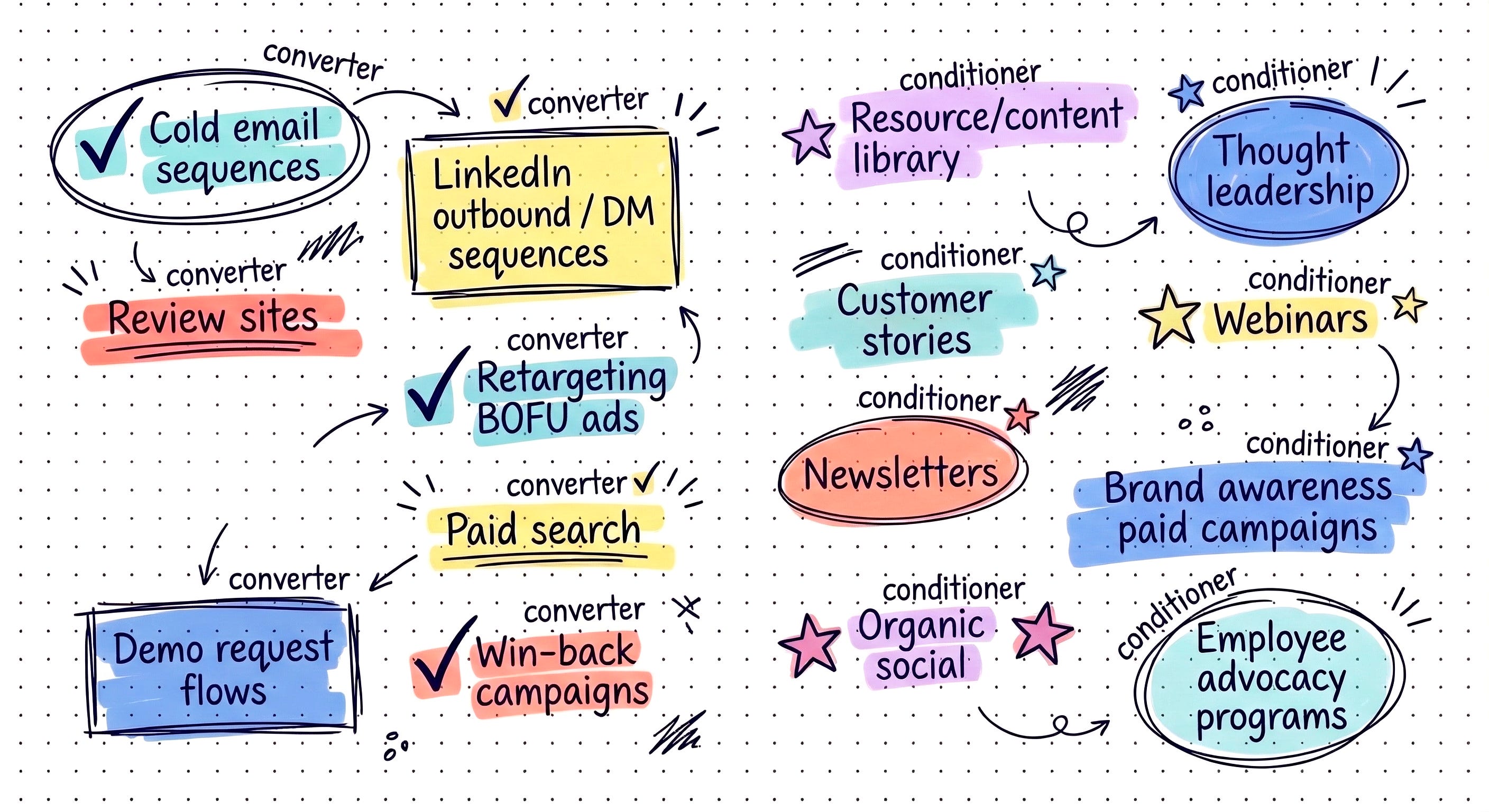
Most teams will find conditioners being held to converter metrics. That mismatch is where the budget arguments live. Fix the classification, and a lot of those arguments either resolve or get a lot shorter.
Most issues I see in business come from not being aligned or missing communication. When you can cleanly define concepts into frameworks it helps communication, especially for non-marketers (hi, CEOs and finance!). It gives everyone a shared language for a conversation that usually happens without one.
The problem was never the program. It was that nobody agreed on what the program was supposed to do.
What does your program classification look like right now? Any other way you’ve found helpful to illustrate this? Hit reply, I read everything and want to hear what you’re navigating!
*AI disclaimer: AI was used in copy editing and refinement along with image creation. All frameworks, observations, ideas, and opinions are my own.
This framing is so useful. The biggest trap I see teams fall into is measuring conditioners like converters and then killing programs that were actually doing their job well. The 3 step audit at the end is practical enough to run in a single meeting. Great piece.